Did Team Double Dragon Stop Ck2 Again
Behemothic Bomb News
110 Comments
Off The Clock: My Own Personal Investigation Team
After years of trying to brand it happen, I finally got to play Sherlock Holmes: Consulting Detective. I was not disappointed.
Welcome to Off the Clock, my weekly cavalcade virtually the stuff I've been doing while out of the role. This weekend, I spent my costless time…
Solving Mysteries
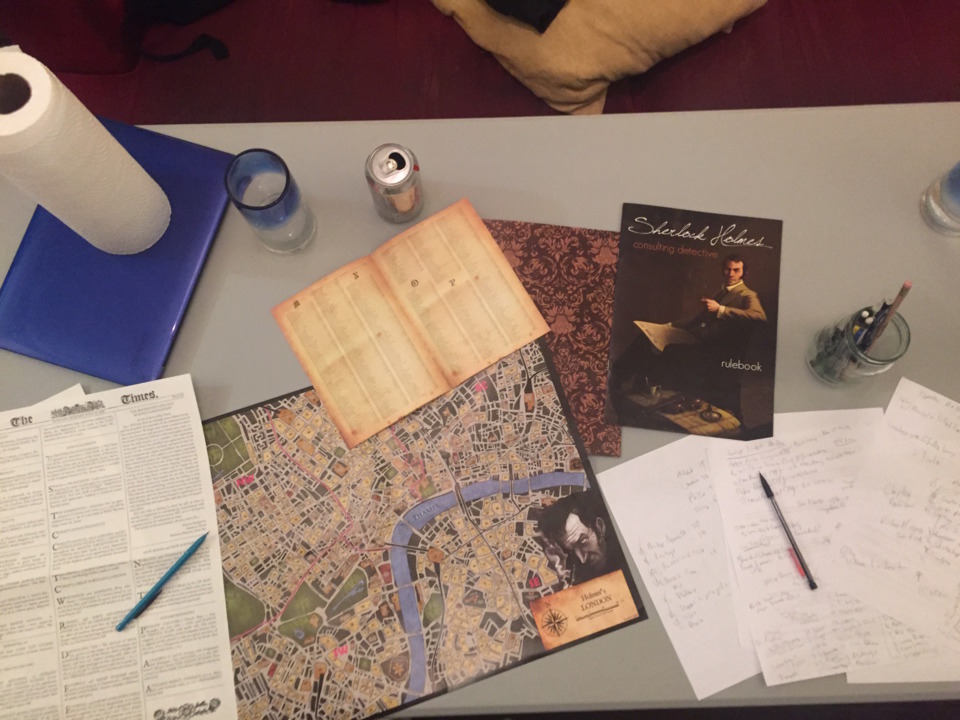
After years of trying to find an affordable re-create of Sherlock Holmes: Consulting Detective (plus a handful of friends willing and able to play with me), I finally got the opportunity to dig into this classic mystery/take chances game. (At that place's an FMV accommodation of the board game, too, but I don't really take any experience with that.)
For the uninitiated, Sherlock Holmes: Consulting Detective casts the players as the Bakery Street Irregulars, a group of misfit investigators that Holmes occasionally relies on for information gathering and reconnaissance. At the commencement of the game one thespian reads aloud from a case booklet, setting up a murder or a theft or some other mystery that needs to be figured out. Once the introduction is over, players race against Holmes to try and solve it.
How practise you do that? Well, you do what whatsoever skilful investigators would do. You gyre out a map of London, peruse the day'south paper, and flip through a hefty "directory"--sort of like a telephone book--and determine where in town to go. Every building in town has a designator (Buckingham Palace is SW35, for case), and when y'all decide where you want to go you, you open up the case booklet to that designator and read the text that's written there. It could exist a long, multi-page interview with a suspect or a short paragraph about something (seemingly) irrelevant to your investigation. Sometimes it'southward naught at all… whoops. One time you call up you take a handle on what happened, you turn to the end of the instance booklet and attempt to answer 6 questions posed by Holmes about the crime (and its next intrigues). You get points for getting the answer right and lose points for taking more turns (that is, visiting more points on the map) than Holmes did.
None of this would work if the mysteries were simple riddles (or even complex logic puzzles). If all yous had to practice was assemble the evidence and line information technology up nicely, SH:CD wouldn't produce that special awareness that y'all get when you finally practise effigy something out. Y'all can't accept the feeling of finding a needle in a haystack without the hay, and you can't feel like yous've unraveled someone's carefully guarded secret life without their life feeling messy and filled with irrelevant details.

It's really hard to enlarge the breadth of information bachelor for y'all to observe in any private case. In our first game, the CEO of an arms manufacturing company was plant expressionless in an aisle outside company headquarters, and even afterwards visiting multiple locations and getting what we thought was a fair amount of information on the case, nosotros notwithstanding had a lot of questions. Was the killing due to internal strife at the company? Was information technology tied to international corporate or military intrigue? Was a scorned lover involved, and if so which i? Each of these questions emerged out of multiple investigation points, seated carefully in a variety of sub-stories and character perspectives.
The first time through, we played with the intention of "winning" the game--largely considering the Holmes of SH:CD is but every bit smug as his literary original. So, later just x turns, we convinced ourselves that we knew what happened and we went back to 221B Baker Street. Nosotros flipped to the back of the book, answered Holmes' questions, read his solutions and realized that we could not have been more than wrong. Whoops, once again.
It was a learning feel, not only because we understood the game better, but because we learned what we wanted from the game. So nosotros started the 2nd instance (this time about the death of an octogenarian general, the Battle of Waterloo, and… a jewel heist? Maybe?), and nosotros decided to accept a much less competitive mental attitude. In a sense, nosotros were playing information technology the mode many played Her Story, the database driven mystery game that got a ton of attending earlier this year. We weren't racing against Sherlock, we committed to investigating until nosotros were satisfied. (And, for the tape, nosotros even so got things incorrect. Don't hire us as your detectives, I guess.)
Honestly, it'south hard not to compare SH:CD to Her Story. Both are games that feature open up-ended investigation, and SH:CD is a swell reminder that Her Story shouldn't be lauded simply for being "fresh," either. As Twitter user @VorpalFemme pointed only subsequently it released, Her Story is not the first game on the market to feature database diving and non-linear storytelling. She notes that Christine Love's Digital: A Love Story and Analogue: A Hate Story both let players dig through email correspondence in a way similar to Her Story'southward faux-desktop detective work. Taken more than broadly, Emily Curt'southward Galatea and First Draft of the Revolution offer unique takes on interactive exposition that blur the line between narrative "exploration" and authorship. And on a contempo episode of Idle Thumbs, Nick Breckon realizes that Ancestry.com's uses "multiplayer" hooks and game-y reward systems to encourage a similar sort of "one-more than-click" style of play.
It's easy to find ourselves saying something similar "Game X has done something no other game has done before," only we should be careful of making those sorts of claims. The structure of the manufacture has historically made it easier for some games to "pierce" into the wider consciousness than others, and (though it's a constant challenge) we should do our best to augment the telescopic of our knowledge about the medium instead of making hyperbolic claims about originality. Across that, though, we should besides do more than just say "this game is good considering information technology does something new," since humid any of these games down to their novelty alone does them a disservice. Instead, we should engage with their specific qualities. How practice they execute on the concept of non-linear storytelling? What detail feeling does investigation create for the histrion in these games?
In the instance of Sherlock Holmes: Consulting Detective, it is the game's quality of materiality that distinguishes it for me. Information technology'south the feeling of flipping through pages, pointing at spot on the shared map on a tabular array, measuring the altitude traveled by a suspect to come across if their alibi adds up. It's fifty-fifty the fact that "the answers" exist in the volume, waiting to be seen, constantly tempting your eyes. When I say "materiality," I mean more than just the game's physical attributes, too: Even the way the game is designed feels, somehow, touchable and existent. For instance, as you complete cases, previous newspapers remain "in play"--in the second instance we found an important clue in the broadsheet from in-game months prior. Your knowledge about the city and its inhabitants increases as you play, too, and it'due south easy to find yourself slipping into character: "Well… Nosotros practice know that guy at the city records department… Mayhap he could tell us something?"
It'due south a more objective-oriented mystery than Her Story and a less emotional one than Analogue, just it took me over in a way that neither of those games did. To lift a term from virtual reality marketing, information technology'southward a game with presence. Simply as, in the Elite: Dangerous VR demo, I forgot for the slightest moment that the airplane pilot'south mitt wasn't actually my hand, there were moments playing Sherlock Holmes: Consulting Detective where my encephalon's neurons fired in a dislocated blueprint, so certain that I was swell a existent, of import mystery wide open. Brief moments, yes, but intense nevertheless. A quarter second hither, where I realize that someone's excuse doesn't add up; a one-half 2d there, when the evidence I've been hoping to notice for the last two hours start springs into view; the length of the grin I gave my friend as he read the damning witness testimony aloud.
So far, I've worked through two of the game'southward ten cases. That means there are eight more mysteries to solve... plus an expansion due quondam in 2016. I cannot wait to dive dorsum into the streets of London again.
A quick question for you all, though: So much of my experience of Sherlock Holmes: Consulting Detective changed when we decided to focus on solving the mystery instead of only trying to beat Sherlock's score. Do you have whatever gaming experiences where, because y'all shifted your focus/goals, your experience was greatly improved? Maybe you lowered (or increased) the difficulty in an FPS or mayhap you decided to play as a different class in an RPG? Mayhap it'southward even about who (or where, or when) you decided to play something? Let me know!
Oh, and considering our answers have been and so practiced every week, I'm going to first grabbing a handful of my favorite comments and highlighting them in a mail every Fri afternoon! If you'd prefer your respond not to be included in that post, let me know and I'll respect that.
I also spent some this time this calendar week...
Listening to: "Sunshine" by Pusha T
Reading: "Get rich or dice vlogging: The pitiful economic science of internet fame" by Gaby Dunn
Watching: Rifftrax's Star Wars Vacation Special Commentary (Go for the Wookies, stay for the 70s Television set ads).
mcgovernrearmiend85.blogspot.com
Source: https://www.giantbomb.com/articles/off-the-clock-my-own-personal-investigation-team/1100-5326/?comment_sort=m.dateCreated&comment_direction=ASC&comment_page=2
0 Response to "Did Team Double Dragon Stop Ck2 Again"
Post a Comment